Working as a physiotherapist in Switzerland: figures on vacancies and international professionals
Working as a physiotherapist in Switzerland is becoming increasingly popular among healthcare professionals from Europe. Due to the shortage of physiotherapists, Swiss practices are increasingly looking for international candidates, a trend that PhysioMatch observes on a daily basis.
In this article, you can find out how many physiotherapists work in Switzerland, why there is a shortage, and from which countries foreign physiotherapists are moving to Switzerland.
Working as a physiotherapist in Switzerland: figures on vacancies and international professionals
Working as a physiotherapist in Switzerland has become increasingly popular among healthcare professionals across Europe. This is no surprise, as many Swiss practices have been struggling to fill open positions for quite some time. Due to the shortage of physiotherapists, employers are increasingly looking for international candidates, a development that PhysioMatch sees every day in practice.
In this article, you will read how many physiotherapists work in Switzerland, why shortages continue to exist and why international professionals are becoming increasingly important. We also show which countries physiotherapists move from based on the candidates PhysioMatch has placed in Switzerland over the past three years.
- Approximately 15,199 physiotherapists work in Switzerland
- The average working week is around 32.7 hours
- Around 28.2 percent leave the profession within two years
- The number of recognised foreign diplomas has been rising for years
- PhysioMatch has placed candidates from a broad mix of European countries over the past three years
Key figures at a glance


How large is the physiotherapy sector in Switzerland
According to research by ZHAW, around 15,199 physiotherapists work in Switzerland. The sector has several clear characteristics. Around 76 percent of physiotherapists are women and the average age is around 42 years. In addition, about 61 percent work in outpatient practices and 84.5 percent work within the healthcare system.
Another important factor in Switzerland is the number of hours physiotherapists work on average. The average working week is around 32.7 hours, which means part time work is very common. That is positive for the work life balance of many professionals, but it also means that the available full time capacity in the sector is lower than the total number of professionals might suggest.
At PhysioMatch, we see the impact of this in daily practice. Swiss practices regularly look for new colleagues to keep schedules covered, reduce waiting times and safeguard continuity of care. As a result, physiotherapy vacancies continue to reappear in many regions.
Why there is a shortage of physiotherapists in Switzerland
Besides part time work, outflow also plays a major role. Research shows that around 28.2 percent of physiotherapists temporarily or permanently leave the profession within two years. This is a substantial share and means employers must recruit repeatedly to maintain their teams.
This outflow consists of different groups. Around 10.8 percent move into another profession. About 9.4 percent temporarily interrupt their career. Another 7.9 percent go on to work outside the regular healthcare system. Together, these movements create long term pressure on the labour market, even when new physiotherapists enter the profession.
This is visible in vacancy overviews. In October 2025, PhysioSwiss reported 217 open physiotherapy vacancies. On the platform TherapieJobs.ch, 626 open positions were listed. The exact numbers change throughout the year, but the underlying trend is clear. Practices are continuously looking for reinforcement.
PhysioMatch sees that Swiss employers therefore increasingly look at international candidates. Especially when a team needs to be expanded quickly, recruitment in other European countries can make a real difference.
Growth of foreign physiotherapists in Switzerland
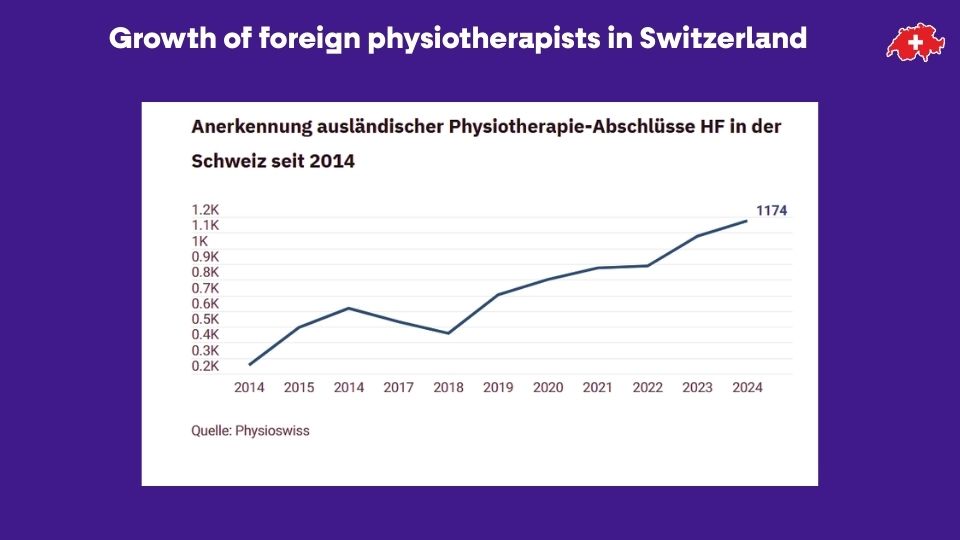
To help address shortages, the inflow of physiotherapists from abroad continues to grow. This is reflected in the number of recognised foreign diplomas. The number has been increasing for years. In 2024, 1,174 foreign physiotherapy diplomas were officially recognised.
For candidates, this means Switzerland is becoming increasingly international. For employers, it means the recruitment market has widened. Practices look more often at physiotherapists from across Europe, especially when the local labour market is too tight.
At PhysioMatch, we also see this clearly in conversations with Swiss employers. International inflow is no longer an exception for many teams, but a logical part of workforce planning.
Recognition of foreign physiotherapy diplomas
Anyone who wants to work as a physiotherapist in Switzerland usually needs diploma recognition through the Swiss Red Cross. This is an important part of the preparation process and ultimately determines whether someone can start working in Switzerland without restrictions.
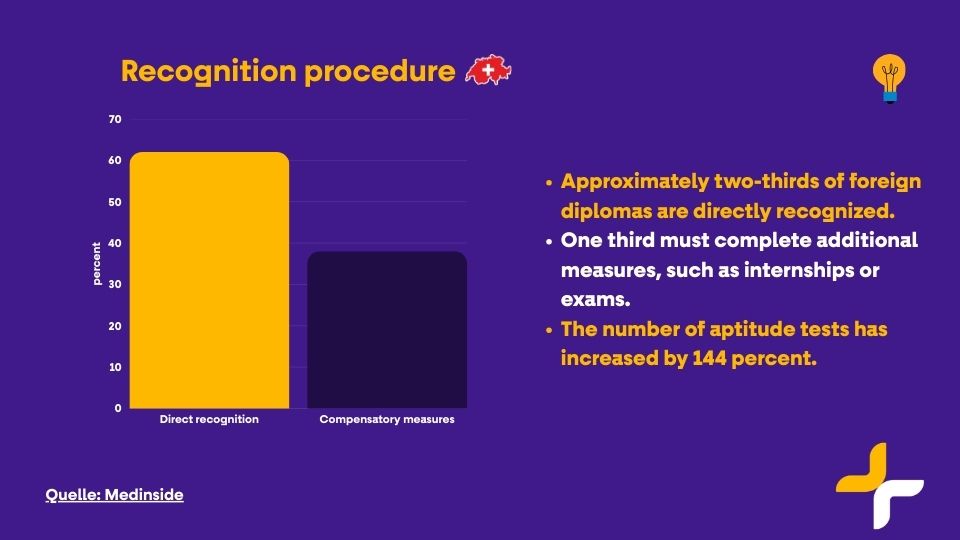
In practice, around two thirds of diplomas are recognised directly. About one third of candidates need to complete additional measures, such as an adaptation placement or an exam. The number of aptitude exams has increased strongly in recent years, which shows that the inflow is growing and that the process requires extra steps for some candidates.
PhysioMatch supports physiotherapists throughout this process and helps with collecting and organising the documents required for the application. This creates more clarity and helps prevent delays in a process that can feel new and complex for many candidates.
Which countries physiotherapists move from to Switzerland
Based on the professionals PhysioMatch has placed in Switzerland over the past three years, we see a clear geographical spread. The inflow mainly comes from a number of key countries, supplemented by a broad group of other European countries of origin.
Top 6 countries of origin via PhysioMatch
- Netherlands, 187
- Germany, 50
- Spain, 25
- Switzerland, 21
- Belgium, 16
- Greece, 15
In addition, PhysioMatch has also placed physiotherapists from Italy, Hungary, France, Poland, Portugal, Finland, Austria, Slovakia, Romania, Bosnia and Herzegovina, Bulgaria, Estonia, Croatia, Malta, Slovenia, the Czech Republic, the United Kingdom and Sweden.
This broad origin mix shows that Switzerland has become an international labour market for physiotherapists. European mobility now plays an important role in staffing the sector.
Origin of physiotherapists placed in Switzerland by PhysioMatch over the past three years. Larger circles represent more placements.
The role of PhysioMatch in working as a physiotherapist in Switzerland
Due to the structural shortage, Swiss healthcare providers continue to look for new professionals. PhysioMatch helps physiotherapists from across Europe find work in Switzerland and supports them throughout the full application process.
The guidance focuses on creating a clear route towards starting a new job in Switzerland. From introductions with employers to support during preparation for relocation and diploma recognition, the step towards Switzerland becomes more concrete and easier to manage.
Frequently asked questions about working as a physiotherapist in Switzerland
Is there a shortage of physiotherapists in Switzerland?
Yes. Several regions in Switzerland experience a shortage of physiotherapists. This is partly due to the high share of part time work and because a number of professionals leave the sector within a few years. As a result, physiotherapy vacancies often remain open for longer.
Can foreign physiotherapists work in Switzerland?
Yes. Many physiotherapists from other European countries work in Switzerland. However, a foreign diploma usually needs to be recognised by the Swiss Red Cross first. After recognition, foreign physiotherapists can work in Swiss practices, clinics or rehabilitation centres.
How does recognition of a physiotherapy diploma work in Switzerland?
To have a foreign physiotherapy diploma recognised, candidates must submit an application to the Swiss Red Cross. Around two thirds of diplomas are recognised directly. In other cases, it may be necessary to complete additional steps such as an adaptation placement or an exam.
Which countries do physiotherapists in Switzerland come from?
Physiotherapists working in Switzerland come from many different European countries. Based on placements by PhysioMatch, the largest groups come from the Netherlands, Germany, Spain, Belgium and Greece. In addition, physiotherapists from many other European countries also move to Switzerland for work.
How does PhysioMatch help physiotherapists work in Switzerland?
PhysioMatch supports physiotherapists throughout the entire recruitment process in Switzerland. This includes finding a suitable employer, support with diploma recognition and guidance during preparation for working and living in Switzerland.
Would you like a personal conversation?
Emigrating isn't something you do every day, thankfully. We understand there's a lot to consider. Register now and explore your options in Switzerland with us.