
Medical German
In the German-speaking part of Switzerland, mainly Swiss-German is spoken. For most foreigners, this is difficult to understand at first. Every Swiss person also speaks High German. You can explain at the beginning of the conversation that you have not been working there for long and that they might be able to speak High German.
- Ich arbeite noch nicht so lange in der Schweiz. Können Sie bitte Hoch-Deutsch sprechen?
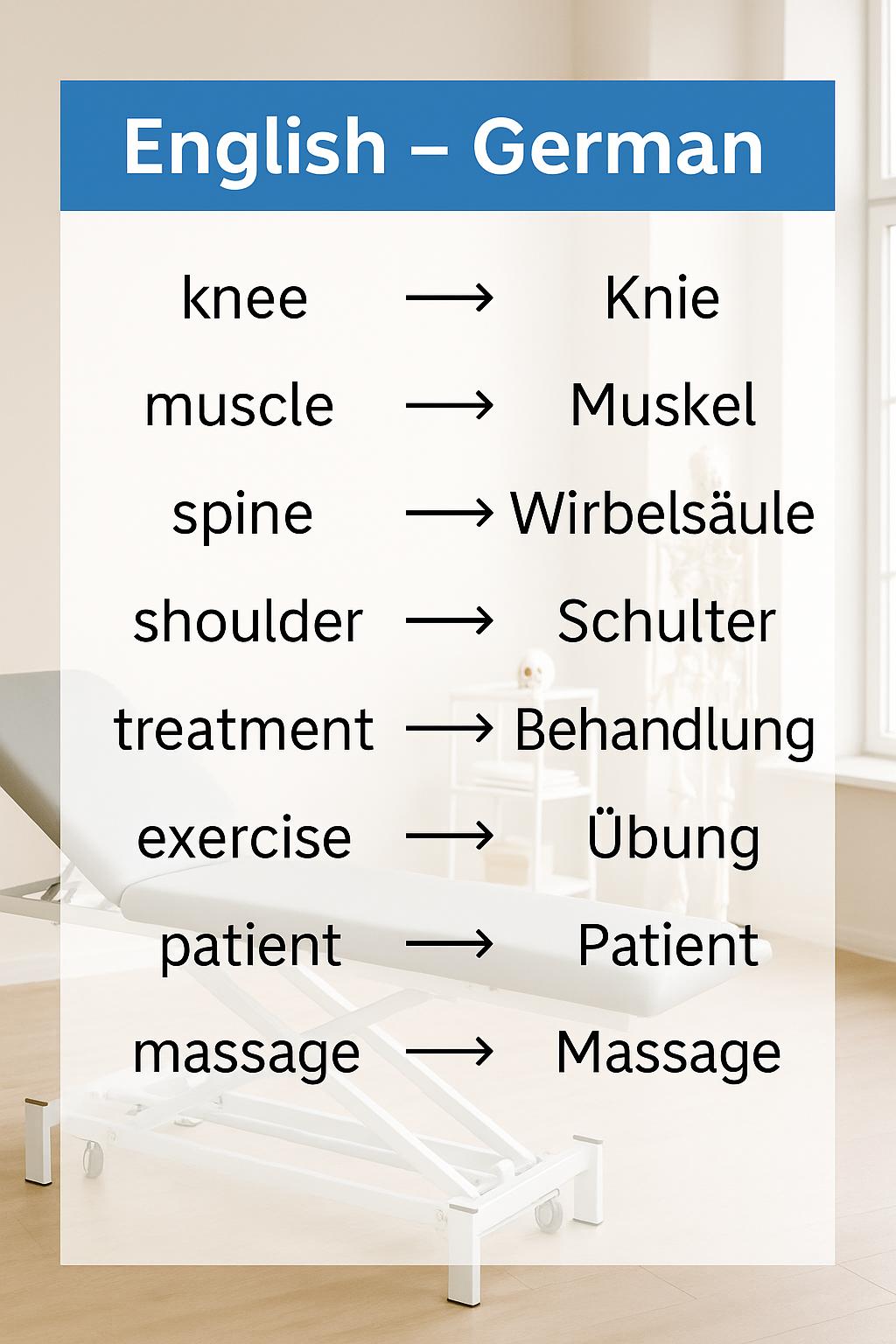
German translations of the most common things in healthcare
Smalltalk
At the beginning of a treatment, you often ask a few questions to put the patient at ease. Here are a few common questions.
Beautiful weather outside, isn’t it?
Schönes Wetter draußen, nicht wahr?
Were you able to find it?
Sind Sie gut in der Praxis angekommen?
How was your weekend?
Wie war Ihr Wochenende?
How are your children, your husband, your wife, your dog?
Wie geht es Ihren Kindern, Ihrem Mann, Ihrer Frau, Ihrem Hund?
Medical history
To get you started, we have translated the most common anamnesis questions into German. You can memorise the questions before you start or keep this page with you at the beginning.
What are your symptoms?
Was sind Ihre Beschwerden?
How did the complaints start?
Wie sind Ihre Beschwerden entstanden?
When did the complaints start?
Wann sind Ihre Beschwerden entstanden?
How is your complaint progressing?
Wie ist der Verlauf der Beschwerden?
Do the symptoms affect your daily activities?
Machen Sie all Ihre täglichen Aktivitäten wegen der Beschwerden?
With which daily activities do you have problems?
Mit welchen Aktivitäten haben Sie momentan Probleme?
Do you have a profession? What exactly do you do for work?
Haben Sie derzeit einen Job? Was für eine Arbeit machen Sie genau?
Do you have hobbies and do you play sports?
Haben Sie Hobbys und machen Sie Sport?
Are you in good health, apart from your current complaints?
Sind Sie neben Ihren Beschwerden gesund?
Are you currently taking any medicines, and if so, which ones?
Nehmen Sie derzeit Medikamente ein und wenn ja, welche?
What do you expect from me?
Was erwarten Sie von mir?
In addition to the medical history, you will have to ask patients a few things. Below are frequently used sentences in the treatment room, translated into German.
You may sit on the chair or treatment bench.
Sie dürfen Platz nehmen auf den Stuhl, die Liege.
You may take off or put on your clothes.
Sie dürfen Ihre Klamotten ausziehen, anziehen.
You may take off your trousers or shoes.
Sie dürfen Ihre Hose, Schuhe ausziehen, anziehen.
You may take off your shirt or pullover.
Sie dürfen Ihr T shirt, Ihren Pullover ausziehen, anziehen.
Can you stand up?
Können Sie aufstehen?
Can you sit down?
Können Sie sich hinsetzen?
Can you lie on your back or belly?
Können Sie sich auf den Rücken, Bauch hinlegen?
Can you lie on your left or right side?
Können Sie sich auf die linke, rechte Seite hinlegen?
Can you stand on one leg?
Können Sie auf einem Bein stehen?
Can you bend forward?
Können Sie sich nach vorne beugen?
Can you bend sideways? To the left or right.
Können Sie sich seitwärts beugen? Nach links, rechts.
Can you stretch your back as far as possible?
Können Sie den Rücken so weit wie möglich strecken?
Can you turn your neck or back? To the left or right.
Können Sie den Hals, Rücken drehen? Nach links, rechts.
Below is a drawing of a person with all the German words of the body parts written next to it. Useful to know: For each plural word, the article automatically becomes DIE. For example: DER Kopf becomes DIE Köpfe in the plural or DAS Knie becomes DIE Knie in the plural. Behind each word in the drawing is a description of what else the word in plural has changed besides the article. For example: DAS Auge becomes DIE Augen or DER Mund becomes DIE Münder in plural.
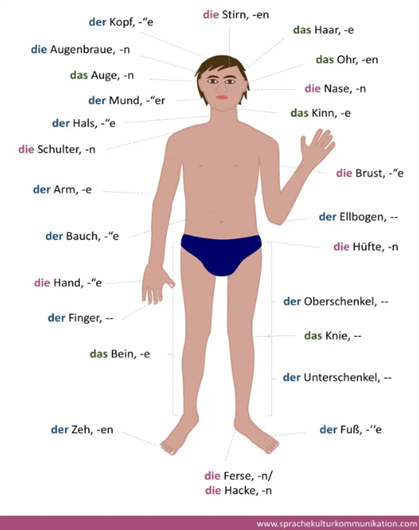
Translations
It is good to know what the objects around you are called in German. Below are the most common objects from a treatment room and the practice room translated into German.
Treatment room
| English | Deutsch |
|---|---|
| The (treatment) room | Das (Behandlungs) Zimmer |
| The couch | Die Liege |
| The chair | Der Stuhl |
| The desk | Der Scheibtisch |
| The table | Der Tisch |
| The sink | Das Waschbecken |
| The wall | Die Wand |
| The floor | Der Boden |
| The ceiling | Die Decke |
| The door | Die Türe |
| Window | Das Fenster |
| The radio | Das Radio |
| The picture | Das Gemälde, Das Bild |
| Curtain | Der Vorhang |
| The computer | Der Computer |
Practice room
| English | Deutsch |
|---|---|
| The practice room | Das Trainingsraum |
| The pully | Das Zuggerät |
| The wall bars | Die Sprossenwand |
| The dumbbell | Die Hantel |
| The barbell | Die Langhantel |
| The mat | Die Matte |
| The leg press | Die Beinpresse |
| The ball | Der Ball |
| The bench | Die Bank |